
Description
Core Reflex Loop
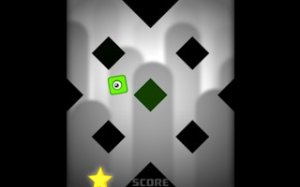
GlideDash Precision Arcade puts a small cube under your control at the center of a stripped-back screen. Taps shift the cube left or right. Dashed lines are your scoring gates: pass through one and you earn a point. Solid obstacles are the opposite — touch one and the run ends immediately. There is no health bar and no second chance within a run, so every tap carries weight.
How Speed Changes the Decision
The game does not stay at one pace. Each successful pass through a dashed line raises the speed, which compresses the window for every movement. Early on, you have time to read the screen and adjust. Later, the same left-right choice has to happen in a fraction of the moment, and the cost of a late tap becomes a solid block. The difficulty curve is therefore built into the scoring system: the better you do, the faster the game asks you to think.
Reading the Pattern
Obstacles appear in predictable patterns rather than random chaos. That design choice matters because it turns the game into a rhythm exercise as much as a reaction test. Players who watch the spacing between dashed lines and solid blocks can start to anticipate the next move instead of reacting to it. The cube glides smoothly, so the limiting factor is almost always your timing, not the controls.
Session Design and Audience
Runs are short by nature. A single mistake ends everything, and restarting is immediate, which makes the game easy to pick up for a few minutes or to repeat for a longer practice block. The clean visuals and one-tap input keep the focus on the action, and the absence of complex rules means no tutorial is needed. It suits players who enjoy coordination challenges and want a straightforward score to beat.



Editorial Notes